
If you’ve ever wondered how to improve sales skills as part of building a sustainable design practice, you’re not alone. Many professionals focused on interior design business growth struggle to convert enquiries into committed clients, not because of a lack of talent, but because of gaps in communication and process. Sales is often misunderstood as persuasion, when in reality it is about clarity, confidence, and guiding decisions.
For every ArchDesignpreneur, learning to improve sales skills is less about scripts and more about mastering conversations across the client journey. In an ArchDesign business, every interaction influences whether a client moves forward or hesitates. When done right, sales becomes a natural extension of your expertise, not an uncomfortable add-on.
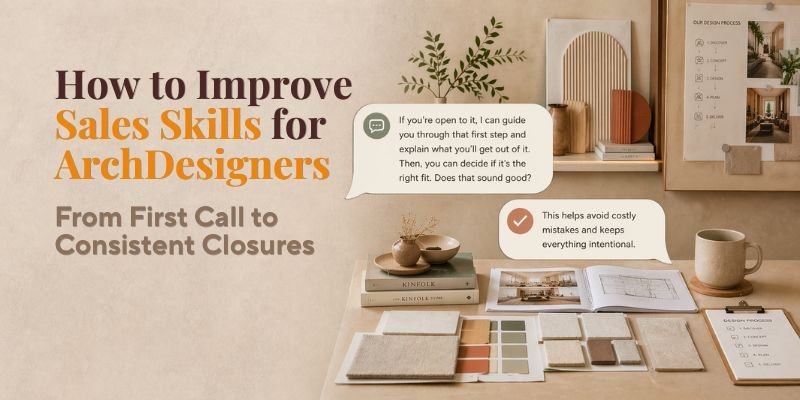
How to Improve Sales Skills by Fixing the First Client Interaction
The first client interaction is where your sales success truly begins. Before proposals, pricing, or presentations, it’s this initial moment that shapes how a client perceives your professionalism, clarity, and confidence. When handled intentionally, it can instantly build trust and position you as the right choice.
- The first interaction sets the tone for the entire relationship. Whether it’s an inquiry response or an initial call, this stage determines how clients perceive your professionalism and clarity. A delayed or vague response can weaken trust, while a structured and confident reply builds immediate credibility.
- Setting authority from the first conversation is not about dominance but about providing clear direction. Clients are naturally looking for someone who can guide them through decisions, and this expectation begins immediately. The way you frame your conversation shows whether you are leading the process or just reacting to it.
- Qualifying leads is a critical step in improving your sales effectiveness. Not every inquiry is the right fit, and trying to convert everyone often leads to misaligned projects. Having clear filters ensures you focus your time and energy on serious, aligned clients.
- Using questions to diagnose rather than impress shifts the conversation entirely. Instead of showcasing your expertise upfront, you focus on understanding the client’s needs, preferences, and challenges. This approach builds trust and positions you as a thoughtful problem-solver rather than just a service provider.
How to Improve Sales Skills During Client Consultations
Client consultations are where decisions begin to take shape. This stage requires a balance of listening, guiding, and structuring the conversation. Without this balance, even promising projects can stall due to confusion or lack of clarity.
A. Asking Better Questions
Asking better questions helps uncover lifestyle needs, pain points, and the client’s vision of success. These insights go beyond surface-level requirements and reveal what truly matters to the client.
Understanding constraints such as timelines and budgets also ensures realistic alignment. Without this clarity, expectations can quickly become mismatched.
It is equally important to identify who makes decisions and how those decisions are made. This prevents delays and ensures smoother communication throughout the process.
When questions are intentional and relevant, they create a strong foundation for confident decision-making.
B. Controlling the Conversation Flow
Leading a conversation does not mean dominating it. It means guiding the discussion in a way that keeps it focused and productive. Clients feel more comfortable when there is a clear direction.
Without structure, conversations can drift, leading to confusion and missed details. This lack of clarity often results in hesitation later in the process.
Preventing scope creep at the conversation stage is equally important. When boundaries are unclear early on, expectations expand without alignment. A well-guided conversation ensures that both sides remain aligned and focused on outcomes.
C. Building Trust Without Giving Free Design
Trust is built through clarity, not through over-delivering prematurely. Sharing too many ideas too early can reduce perceived value and blur professional boundaries.
Clients often associate structured processes with expertise. When everything is given away upfront, it can make the service feel undefined.
Drawing boundaries ensures that each stage of the process has purpose. It also reinforces the value of your time and expertise. Clarity converts better than generosity because it creates confidence in the overall experience.
How to Improve Sales Skills Through a Structured Design Process
A structured design process is a powerful tool to improve your sales approach. It helps you communicate clearly, build trust, and guide clients confidently through their decisions. When your process is well-defined, clients feel more assured, making it easier for them to say yes.
- A clear process shows clients exactly what will happen next. This reduces uncertainty and makes them feel secure in moving forward.
- Presenting your work in phases instead of one large fee simplifies decision-making. Clients can better understand value when it’s delivered step by step.
- Explaining each stage of the process helps clients know what to expect. This openness builds trust and reduces hesitation.
- A structured approach reflects intention and expertise, not rigidity. It shows that your system is designed for results, supporting interior design business growth.
How to Improve Sales Skills When Presenting Fees and Proposals
Presenting fees is often where many professionals feel uncomfortable. Shifting from cost explanation to investment framing changes how clients perceive the value of your service.
When fees are presented confidently and succinctly, clients are more likely to accept them without resistance. Over-explaining often creates doubt rather than clarity.
Handling price objections requires calm and clarity. Instead of defending every detail, focus on reinforcing the outcomes and value being delivered.
Knowing when to walk away is equally important. Not every client is the right fit, and misaligned projects can affect both experience and profitability in an ArchDesign business.
How High-Performing Interior Designers Close Projects Consistently
High-performing professionals focus on outcomes rather than deliverables. Clients are more interested in the transformation than the process itself. This shift in focus creates stronger alignment and commitment.
Consistency in messaging across websites, calls, and proposals reinforces trust. When clients hear the same clarity at every stage, they feel more confident in their decision.
Knowing when to follow up and when not to is a key differentiator. Timely follow-ups maintain momentum, while excessive follow-ups can create pressure.
Creating urgency without pressure helps clients move forward naturally. It keeps the process active without making clients feel rushed or uncomfortable.
How to Improve Sales Skills as Your Interior Design Business Grows
As your business evolves, your sales approach must evolve as well. What works at an early stage may not be effective as complexity increases. Adapting your approach is essential for long-term success.
Selling as a solo professional is different from leading a team. As responsibilities grow, the focus shifts from personal interactions to systems and processes.
Transitioning from personal selling to system-based selling ensures consistency. It allows your ArchDesign business to scale without relying solely on individual effort.
An important aspect is understanding how often to re-evaluate sales competencies and skills. Regular review helps identify gaps, refine processes, and maintain alignment with business goals. As often highlighted by Shanker De, the ArchDesign Business Coach (ABC), continuous refinement is key to sustainable growth.
Signs Your Sales Skills Are Improving (Even Before Revenue Jumps)
One of the first signs of progress is fewer price objections. When value is communicated clearly, clients are less likely to question fees.
Faster client decisions also indicate improved clarity and confidence. Clients move forward more quickly when they understand the process and outcomes.
Another positive sign is attracting better-fit clients. When messaging and conversations are aligned, the right clients naturally resonate with your approach.
Increased confidence in conversations is often the most noticeable shift. As a confident ArchDesign business owner, this confidence reflects in every interaction, making the process smoother and more effective.
Conclusion
Learning how to improve sales skills is not about adopting tactics, but it is about refining how you communicate, guide, and build trust throughout the client journey. For every ArchDesignpreneur, sales become easier when clarity replaces complexity and structure replaces uncertainty.
Consistent results come from consistent conversations. When your process, messaging, and mindset are aligned, conversions become a natural outcome rather than a struggle. This is what drives sustainable interior design business growth in the long run.
What part of your sales process feels most challenging right now? Drop your thoughts in the comments, and I’d love to hear from you.
If you’re ready to improve sales skills and bring more clarity into your client conversations, book a call and take the next step toward building a stronger, more scalable ArchDesign business.

Shanker De is an ArchDesign Business Coach, entrepreneur, and Founder of ArchScale Guild. With 25+ years of experience across 330+ businesses in 15 countries, he helps the founders, principals and studio owners of growing ArchDesign firms, especially in Tier 2 & Tier 3 cities, turning inconsistent leads, silent sales and fluctuating revenue into predictable 2x–5x growth.
Using his proven ArchScale Business Growth Model (BGM), Shanker supports every ArchDesignpreneur in building a scalable ArchDesign business without founder burnout, underpricing, or constant overwhelm.