
If you’ve ever wondered how to ask for a referral without sounding awkward or pushy, you’re not alone. Many professionals in the interior design business growth struggle with this exact challenge, even when they’ve delivered incredible results. The truth is, referrals are one of the most powerful and natural ways to grow, yet they often feel uncomfortable because of how they are approached.
Learning how to ask for referrals in a confident, value-driven way can transform your business pipeline and client quality. In this guide, you’ll discover practical strategies, scripts, and systems to confidently ask for referral opportunities while positioning yourself as a trusted expert.
Why Referrals Are Crucial for Interior Designers
Referrals are the backbone of sustainable interior design business growth because they come with built-in trust.
- When a client recommends your services, the new lead already believes in your credibility, making the sales process smoother and faster. This trust factor is especially important in design services, where emotional investment and financial commitment are high.
- Clients naturally prefer working with someone recommended by people they know, as it reduces perceived risk, attracting high-quality clients who are already aligned with your style and process.
- Compared to paid marketing, referrals significantly reduce acquisition costs while delivering better results.
- For any ArchDesign business, building a referral network creates long-term stability and predictability.
This is exactly what every ArchDesignpreneur aims for when scaling sustainably.
The Biggest Fear Designers Have When Asking for Referrals
Many designers hesitate to ask for referrals because they fear sounding desperate or salesy. This hesitation often comes from a mindset that asking equals imposing, rather than offering value. In reality, when done correctly, referrals are simply an extension of a positive client experience.
Another common concern is damaging client relationships. Designers worry that asking might make things uncomfortable or transactional, especially after a successful project. However, clients who love your work are usually happy to help; you just need to guide them.
Timing confusion also plays a major role. Without clarity on when to ask, designers either ask too early or miss the moment entirely. Understanding the best way to ask for referrals removes this uncertainty and builds confidence.
Referrals feel natural when framed as helping others discover a great solution. When you shift your mindset, asking becomes an act of service rather than self-promotion.
When Is the Right Time to Ask for a Referral?
Timing is everything when learning how to ask for referrals. The best opportunities arise when your client is already excited and emotionally satisfied with your work. This is when their enthusiasm naturally translates into willingness to recommend you.
After a successful project completion is one of the strongest moments to ask. At this stage, clients have experienced your process and seen the transformation firsthand. Their satisfaction is fresh, making their recommendation more genuine.
Another ideal moment is when clients compliment your work. These spontaneous expressions of appreciation are signals that they already value your expertise. Turning that moment into a referral conversation feels seamless and authentic.
You can also ask during project reveals, photoshoots, or while collecting testimonials. These milestones celebrate success, making referrals feel like a natural next step. For any ArchDesign business, recognising these moments can significantly boost referral success.
The Best Way to Ask for Referrals Without Feeling Pushy
Asking for referrals does not have to feel uncomfortable or forced when done with the right intent and clarity. When approached thoughtfully, it becomes a natural extension of a positive client experience rather than a sales tactic.
Keep the request simple and direct
Avoid overcomplicating your message or adding unnecessary explanations. A clear and straightforward request feels more genuine and easier for clients to respond to. Simplicity also reduces hesitation and increases the likelihood of action.
Mention the type of clients you prefer
Be specific about who you want to be referred to so clients know exactly how to help. This clarity improves the quality of referrals rather than just the quantity. It also ensures alignment with the kind of projects you want to attract.
Express appreciation first
Start by acknowledging your client’s trust and the opportunity to work with them. Gratitude builds goodwill and makes the request feel respectful rather than transactional. It reinforces the relationship before asking for anything in return.
Position it as helping someone else solve a problem
Frame referrals as a way to support others who might need your expertise. This shifts the focus from self-promotion to value creation. Clients are more willing to refer when they see it as helping someone, not selling for you.
Script for Asking for Referrals (Interior Designer Examples)
Having a simple script makes it easier to ask for referrals with confidence and consistency. Instead of overthinking what to say, a clear structure helps you communicate naturally while keeping the request professional and effective.
Script 1: Casual Conversation
In day-to-day conversations, keep your referral request light and natural. You can say something like,
“I’ve loved working on your space. If you know someone who’s looking for similar transformation, I’d be happy to help them too.”
This keeps the tone friendly and pressure-free. It works well because it blends into normal dialogue rather than sounding like a formal ask. Over time, this builds confidence as an ArchDesignpreneur.
Script 2: After Project Completion
At project handover, you can say,
“I’m so glad you’re happy with the results. If you know anyone who would benefit from this kind of design support, I’d truly appreciate an introduction.”
This connects the referral request with their satisfaction. It also reinforces the value you’ve delivered. This is one of the most effective ways to ask for a referral.
Script 3: Testimonial + Referral Request
When requesting a testimonial, combine it with a referral ask. For example,
“Your feedback means a lot. If you know someone who might need similar help, feel free to connect us.”
This dual approach maximises the opportunity. It also keeps the request natural and efficient. Many ArchDesign business owners use this method successfully.
Script 4: Referral Partner Script
For architects or builders, say,
“I work with clients who value thoughtful design. If you come across someone needing that, I’d love to collaborate.”
This builds professional partnerships. It also opens doors to long-term collaborations. Strong networks are essential for interior design business growth.
How to Ask for Referrals in Email (Templates for Designers)
Email is one of the simplest and most effective ways to request referrals when approached with clarity and intention. With the right structure and tone, your message can feel natural, professional, and easy for clients to act on.
Email Template 1: After Project Completion
Tip: Focus on gratitude and appreciation
Subject: Thank You & A Small Request
Hi [Client Name],
I just wanted to take a moment to thank you for trusting me with your space. It was truly a pleasure working with you, and I’m so glad we could bring your vision to life.
If you happen to know someone who is looking for thoughtful and well-executed design support, I would really appreciate an introduction. I’m currently working with clients who value a smooth, well-managed design experience.
No pressure at all; just thought I’d ask. Thanks again for being such a wonderful client.
Warmly,
[Your Name]
Email Template 2: Past Client Reconnect
Subject: Checking In – Hope You’re Loving Your Space
Hi [Client Name],
I hope you’ve been doing well and still enjoying your space. I was recently thinking about our project together and wanted to check in to see how everything has been.
If you know anyone who might be planning a home or workspace transformation, I’d be grateful if you kept me in mind or passed along my details. I’m currently taking on a few select projects.
Either way, it would be great to hear how things are going on your end.
Warm regards,
[Your Name]
Email Template 3: Referral Reminder Email
Subject: Quick Note
Hi [Client Name],
I just wanted to follow up on my previous message and say thank you again for your continued support. It truly means a lot.
If someone comes to mind who might benefit from my design services, I’d really appreciate you connecting us. I’m currently working with clients who are looking for a seamless and personalised design experience.
No rush or pressure at all; just a gentle reminder. Thanks again, and I hope all is well with you.
Best,
[Your Name]
Make Referrals Easier for Your Clients
Clients are more likely to refer you when the process is simple. Providing a short introduction message they can forward removes friction and makes it easy to act. This small step can significantly increase referral conversions.
Sharing your website and portfolio link ensures that potential clients get a clear understanding of your work. It also reinforces your professionalism and brand presence. This is essential for interior design business growth.
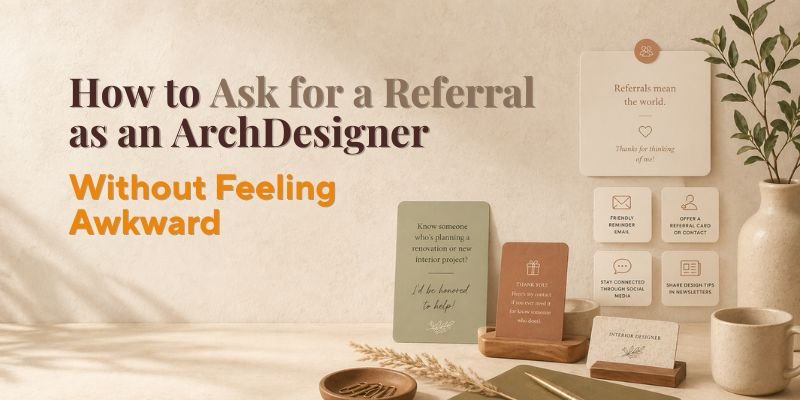
A gift referral strategy with cards or digital contact options gives clients something tangible to share. Whether it’s a PDF or a simple message template, accessibility matters. The easier it is, the more likely they will do it.
Staying connected through newsletters or social media keeps you top of mind. Regular visibility ensures clients remember you when opportunities arise. Don’t forget to thank clients who refer you. Gratitude strengthens relationships and encourages future referrals.
Common Mistakes Designers Make When Asking for Referrals
One of the biggest mistakes is asking too early in the project. Without delivering results first, the request feels premature and weak. Timing plays a crucial role in success.
Another mistake is being vague about the type of client you want. Without clarity, clients struggle to identify who to refer. Specificity makes the process easier and more effective.
Sounding transactional instead of appreciative can damage relationships. Referrals should feel like a natural extension of trust, not a business transaction. Tone and intention matter greatly.
Not following up is another missed opportunity. Sometimes clients simply forget, and a gentle reminder can make all the difference. Also, forgetting to thank the referrer can weaken your network over time.
Building a Long-Term Referral Culture in Your Design Business
Creating a referral culture starts with maintaining strong relationships with past clients. Regular check-ins and updates keep the connection alive beyond the project. This builds loyalty and trust over time.
Staying visible through design insights and content positions you as an expert. When clients see your work consistently, they are more likely to recommend you. Visibility drives referrals naturally.
Building partnerships with architects, contractors, and real estate professionals expands your network. These collaborations create multiple referral channels. This is a key strategy taught by Shanker De (ABC).
A referral-friendly brand experience ensures every client interaction is memorable. From onboarding to delivery, every step should reflect professionalism and care. This encourages clients to talk about your work.
Ultimately, delivering exceptional results is the strongest driver of referrals. When clients love what you do, they naturally want to share it. This is the foundation of every successful ArchDesignpreneur.
Conclusion
Mastering how to ask for a referral is not about scripts alone, but it’s about confidence, timing, and genuine relationships. When you shift your mindset from “asking” to “helping”, referrals become a natural part of your workflow. By applying these strategies, you can consistently attract better clients and grow your business without relying heavily on ads.
If you’re ready to implement these strategies and scale your ArchDesign business, it’s time to take action.
Comment below: What’s stopping you from asking for referrals right now?
Want personalised guidance? Book a call and start building a predictable referral system today.

Shanker De is an ArchDesign Business Coach, entrepreneur, and Founder of ArchScale Guild. With 25+ years of experience across 330+ businesses in 15 countries, he helps the founders, principals and studio owners of growing ArchDesign firms, especially in Tier 2 & Tier 3 cities, turning inconsistent leads, silent sales and fluctuating revenue into predictable 2x–5x growth.
Using his proven ArchScale Business Growth Model (BGM), Shanker supports every ArchDesignpreneur in building a scalable ArchDesign business without founder burnout, underpricing, or constant overwhelm.