
One of the most common website mistakes interior designers make is assuming a visually stunning website will automatically generate enquiries. In reality, your website is a strategic business tool that influences how potential clients perceive, trust, and contact you. As Shanker De, the ArchDesign Business Coach (ABC), often highlights, it’s not just about design; it’s about clarity, positioning, and conversion. Fixing these gaps is essential for consistent interior design business growth.
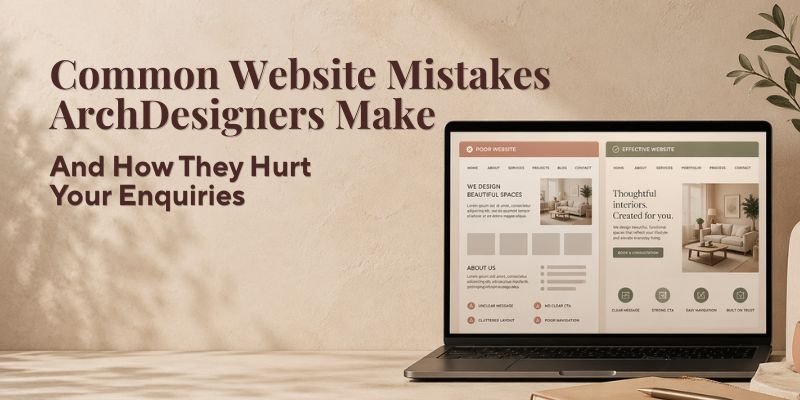
The Real Role of Your Website in an Interior Design Business
Your website is not just a showcase, but it plays a strategic role in your ArchDesign business. It acts as your 24/7 salesperson, working even when you’re not available. Visitors form impressions, evaluate your credibility, and decide whether to contact you all without speaking to you.
It also pre-qualifies leads before discovery calls by communicating your style, process, and expectations. A well-structured website builds trust and authority, helping potential clients feel confident in choosing you. Most importantly, it communicates your brand positioning and pricing indirectly, ensuring that only aligned clients reach out.
Mistake 1: Designing for Aesthetics Instead of Conversions
Many designers focus heavily on making their website look visually stunning but forget usability. Overly complex layouts often confuse visitors, making it hard for them to understand where to look or what to do next. Without a clear visual hierarchy, users feel overwhelmed and leave quickly.
Important actions like “Contact” or “Enquire” are often hidden or not emphasised enough. This results in lost opportunities despite high traffic. The obsession with “looking premium” often replaces the need to guide the user journey.
Fix: Use clear sections, simple navigation, and visible CTAs that guide visitors step by step.
Mistake 2: No Clear Niche or Positioning
A common issue in many ArchDesign business websites is vague messaging like “We design beautiful spaces.” This does not differentiate you or attract a specific audience. Without a defined ideal client, your messaging becomes generic and ineffective.
When visitors cannot identify if you are the right fit for their needs, they leave without enquiring. Lack of positioning also makes you blend into competitors, reducing perceived value.
Fix: Clearly define your niche, whether it’s luxury homes, commercial interiors, or turnkey solutions, and speak directly to that audience.
Mistake 3: Weak or Confusing Homepage Messaging
Your homepage is your first impression, yet many designers fail to communicate clearly. There is often no strong headline explaining what you do or who you serve. Instead, the focus is placed on the designer rather than the client’s needs.
Without a clear value proposition, visitors struggle to understand why they should choose you. This confusion leads to higher bounce rates and fewer enquiries.
Fix: Use a clear headline and subheadline that communicates outcomes. For example: “We design stress-free luxury homes for busy professionals.”
Mistake 4: Poor Navigation and User Experience
One of the website mistakes interior designers make is the poor navigation. Complicated navigation is one of the fastest ways to lose potential clients. Too many menu options create decision fatigue, while hidden pages make important information hard to find.
Additionally, many websites are not optimised for mobile users, which is critical for today’s browsing behaviour. Slow loading speeds further reduce engagement and increase drop-offs.
Fix: Simplify navigation with essential pages like Home, About, Services, Portfolio, and Contact. Ensure your website is mobile-friendly and fast.
Mistake 5: Portfolio Without Context
A visually appealing portfolio is not enough if it lacks explanation. Many designers upload images without describing the project, client challenges, or solutions. This removes depth and reduces the impact of your work.
Without storytelling, potential clients cannot connect with your process or understand your expertise. It also limits your ability to justify premium pricing.
Fix: Add case studies with before-and-after transformations, explain the client’s problem, and highlight your design thinking.
Mistake 6: No Clear Call-to-Action (CTA)
A major conversion issue is the absence of a clear next step. Visitors may like your work but don’t know what to do next. Multiple conflicting CTAs can also confuse users and dilute action. Weak CTAs like “Contact us” fail to create urgency or clarity. As a result, potential leads leave without taking action.
Fix: Use strong CTAs such as “Book a Discovery Call” or “Start Your Project” and repeat them strategically across pages.
Mistake 7: Ignoring Lead Qualification
Without proper filters, your website attracts unqualified leads. This results in time wasted on clients who are not ready, lack budget, or are not aligned with your services.
Many designers skip structured enquiry systems, leading to unclear communication and inefficient discovery calls. This can slow down interior design business growth significantly.
Fix: Use detailed enquiry forms that include budget range, project type, and timeline to pre-qualify leads effectively.
Mistake 8: Lack of Trust-Building Elements
Trust is a key factor in decision-making, yet many websites lack proof. Without testimonials, reviews, or credentials, potential clients hesitate to move forward. Not sharing your story also makes your brand feel impersonal. In a service-based business, connection matters as much as capability.
Fix: Add client testimonials, showcase awards or media features, and include your founder story to build credibility.
Mistake 9: No SEO or Content Strategy
A beautiful website is useless if no one finds it. Many designers ignore SEO and content creation, leading to low visibility. Poor keyword usage means your site doesn’t appear in relevant searches.
Without blogs or educational content, you miss opportunities to attract and nurture potential clients. Local SEO is also often overlooked, limiting regional reach.
Fix: Create blogs targeting client questions, use relevant keywords, and optimise for local searches to increase visibility.
Mistake 10: Treating Website as “Done Once”
Many designers treat their website as a one-time project. Over time, portfolios become outdated, messaging becomes irrelevant, and performance declines.
A static website cannot keep up with evolving business goals or market trends. This leads to missed opportunities and reduced effectiveness.
Fix: Regularly update your website, track performance metrics, and improve based on user behaviour.
Impact of Website Mistakes Interior Designers Make
These website mistakes interior designers make don’t just affect appearance; they directly impact results. Poor structure and messaging lead to low conversion rates, even if traffic is high.
You may receive enquiries, but the quality of leads often remains low, resulting in wasted time and effort. Missed opportunities become common, especially with high-value clients who expect clarity and professionalism.
Most importantly, these mistakes undermine your premium positioning, making it harder to stand out as a confident ArchDesign business owner. For any ArchDesignpreneur aiming for interior design business growth, resolving these issues is not optional, but it is essential.
Conclusion
Your website is one of the most powerful tools in your ArchDesign business. When built strategically, it attracts the right clients, builds trust, and converts consistently. Avoiding these common website mistakes interior designers make can transform your website from a passive portfolio into an active growth engine.
If you found yourself recognising these mistakes on your website, it’s time to take action. Drop a comment below and share which issue you’re currently facing; I’d love to help you identify the right fix.
And if you’re ready to turn your website into a high-converting client machine, book a call today and let’s build a strategy that actually drives results.

Shanker De is an ArchDesign Business Coach, entrepreneur, and Founder of ArchScale Guild. With 25+ years of experience across 330+ businesses in 15 countries, he helps the founders, principals and studio owners of growing ArchDesign firms, especially in Tier 2 & Tier 3 cities, turning inconsistent leads, silent sales and fluctuating revenue into predictable 2x–5x growth.
Using his proven ArchScale Business Growth Model (BGM), Shanker supports every ArchDesignpreneur in building a scalable ArchDesign business without founder burnout, underpricing, or constant overwhelm.