
If you are searching for practical interior design time mastery tips, you are likely juggling multiple projects, client expectations, site visits, vendor calls, and creative deadlines all at once. Time is not just a scheduling issue; it is a profitability issue.
Without structured systems, even a talented professional can feel overwhelmed. True mastery of time is what transforms an overworked practitioner into a strategic, profitable business leader.
In today’s competitive market, managing multiple projects is not optional, but it is the norm. But chaos should not be the price of growth. When systems replace stress, you gain clarity, control, and measurable progress in your ArchDesign business.
Shanker De, the ArchDesign Business Coach (ABC), consistently teaches that structured time management is the backbone of a scalable ArchDesign business. Creativity thrives in structure, not in chaos.
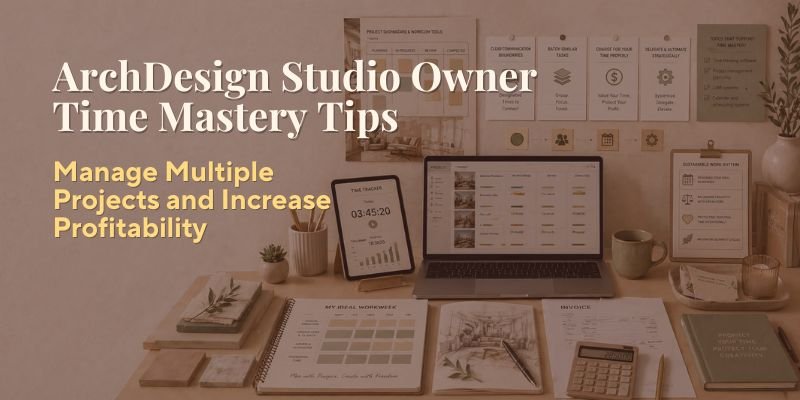
Managing Multiple Projects Without Chaos
One of the most important interior design time mastery tips is learning how to manage multiple projects without creating operational chaos. Handling multiple projects is not about multitasking constantly. It is about building systems that allow you to shift between projects without losing momentum. Effective time management ensures that deadlines are met without sacrificing creativity or profitability.
When processes are predictable, your mind stays creative instead of stressed. A confident ArchDesign business owner understands that structure protects creativity. Let’s explore how.
A. Project Dashboards & Workflow Tools
Before improving productivity, you need visibility. A clear dashboard allows you to see every project phase, deadline, and responsibility in one place. This reduces mental clutter and prevents missed deliverables.
Using project management software
Project management platforms like Trello, Asana, or Studio Designer allow you to map every project stage from concept to installation. Instead of relying on memory, you rely on systems. Tasks are assigned deadlines, dependencies, and responsibilities. This ensures accountability within your ArchDesign business.
Tracking deadlines and deliverables
When you track milestones visually, you can anticipate bottlenecks before they become crises. Timelines become realistic rather than reactive. Deliverables are completed in sequence, not in panic mode. This predictability supports interior design business growth by avoiding rushed errors.
Centralising communication
Scattered communication across WhatsApp, email, and calls leads to confusion. Centralised communication inside project tools keeps everything documented. When instructions are recorded in one place, misunderstandings reduce drastically. That clarity protects both relationships and revenue.
B. Clear Communication Boundaries
Time leaks most often through unstructured communication. Constant availability may seem client-friendly, but it damages focus and productivity.
Setting office hours
Defined working hours set expectations professionally. When clients know when you are available, they respect your boundaries. This reduces late-night calls and impulsive decision requests. Clear office hours reinforce your position as a strategic ArchDesignpreneur.
Structured client update schedules
Weekly or bi-weekly update calls eliminate daily check-ins. Clients feel informed without overwhelming you. Structured updates prevent anxiety-driven communication. Over time, this builds trust and smoother project flow.
Reducing reactive interruptions
Reactive responses drain creative energy. By batching email responses and setting call windows, you control your day. This transforms your workflow from chaotic to intentional. Fewer interruptions mean deeper design thinking.
C. Batch Similar Tasks
Batching tasks is one of the simplest time mastery tips in interior design business that helps reduce context switching and improves productivity. Batching helps your brain stay in one mode longer, improving quality and speed.
Sourcing in bulk
Instead of sourcing for each project separately, group sourcing tasks together. Visiting vendors once for multiple projects saves travel time and mental switching. It also strengthens vendor negotiations. This improves margins within your ArchDesign business.
Grouping client calls
Scheduling client meetings on specific days protects uninterrupted creative days. You remain mentally present during calls instead of rushing. Focused call blocks increase clarity and reduce follow-up confusion.
Content creation batching
If you are building authority online, batch social media or marketing content in one session. Switching between design and marketing daily creates fatigue. Batching keeps branding consistent while saving hours weekly.
Time Tracking for Profit Protection
Among the most overlooked interior design time mastery tips is tracking time accurately to protect profitability. You cannot improve what you do not measure. Time tracking is not micromanagement, but it is financial intelligence. It reveals where effort is profitable and where it is wasted. For interior design business growth, understanding time investment per project is essential.
A. Charge for Your Time Properly
Many professionals underprice their services simply because they do not fully understand the value of their time. Charging correctly is not about being expensive, but it is about being sustainable and profitable.
Understanding your hourly value
Calculate your true hourly rate by including overheads, salaries, and profit margins. Many underestimate this number significantly. When you know your value, pricing decisions become confident and data-driven.
Flat-fee vs hourly models
Flat fees work well when time is predictable and systems are mature. Hourly billing works better during complex or evolving projects. Choose pricing structures strategically rather than emotionally.
Building time buffers into proposals
Delays are inevitable in design projects. Including buffer hours protects your profit margins. Without buffers, small changes accumulate into unpaid labour. Strategic padding is professional foresight, not overcharging.
B. Reduce Scope Creep
Scope creep silently destroys profitability. It begins with “just one small change”. Small, uncontrolled changes gradually consume hours that were never budgeted.
Clear revision limits
Define the number of revisions included in your contract. Once limits are exceeded, additional fees apply. This protects both time and boundaries.
Change order systems
Formal change order documents ensure clarity before new work begins. Clients understand cost and timeline implications upfront. Documentation removes emotional friction.
Educating clients about timeline impacts
When clients understand that changes extend deadlines, they decide more carefully. Education creates mutual respect. This strengthens project discipline across your ArchDesign business.
Delegate and Automate Strategically
Trying to do everything yourself limits scalability. When every decision, approval, and task depends solely on you, it creates a leadership bottleneck that slows growth and increases stress. Delegation is not an expense, but it is a growth strategy.
As Shanker De emphasises leadership begins when you step out of operational overload.
Outsourcing admin or rendering
Administrative tasks consume creative hours. Outsourcing bookkeeping, scheduling, or 3D rendering frees strategic time. This allows you to focus on client experience and revenue-generating activities.
Using templates for proposals and onboarding
Templates reduce repetitive decision-making. Standardised onboarding documents ensure consistency. This improves efficiency and client professionalism simultaneously.
Automating scheduling and follow-ups
Tools like Calendly and automated email sequences eliminate back-and-forth communication. Reminders reduce no-shows. Automation supports professionalism without extra effort.
Tools That Support Time Mastery
Using the right tools is one of the smartest time mastery tips in interior design business for improving efficiency and project clarity. Technology supports systems, but only when used intentionally. Choosing the right tools creates clarity instead of complexity.
Time tracking software
Apps like Toggl or Harvest provide insights into billable and non-billable hours. Weekly reviews highlight inefficiencies. Data-driven decisions replace guesswork.
Project management platforms
Asana, ClickUp, or Studio Designer centralise workflows. Visibility prevents delays. This supports consistent interior design business growth.
CRM systems
Customer Relationship Management tools track leads, proposals, and follow-ups. This ensures no opportunity is forgotten. Sales cycles become predictable.
Calendar and scheduling systems
Digital calendars with colour-coded project blocks create visual balance. Blocking deep-work hours protects creative focus. Scheduling systems maintain professional boundaries.
Creating a Sustainable Work Rhythm
A sustainable schedule is one of the most overlooked interior design time mastery tips for maintaining long-term productivity. Time mastery is not about constant productivity. It is about sustainable performance. Without rhythm, burnout becomes inevitable. A thriving ArchDesign business requires both structure and recovery.
Designing your ideal workweek
Plan creative tasks during peak energy hours. Reserve admin for lower-energy slots. Intentional planning reduces mental fatigue.
Balancing creativity with operations
Creative freedom requires operational discipline. Schedule both design thinking and business management. Neglecting either creates imbalance.
Protecting personal time intentionally
Personal time is strategic recovery, not laziness. Blocking evenings or weekends for family and rest preserves long-term energy. Sustainable growth depends on rest cycles.
Preventing burnout cycles
Burnout occurs when recovery is postponed repeatedly. Regular reviews of workload prevent overload. Conscious planning keeps your ArchDesign business resilient.
Conclusion
Mastering time is not about squeezing more into your day. It is about eliminating waste, protecting billable hours, and building repeatable systems. These interior design time mastery tips are not productivity hacks, but they are structural foundations for profitability.
When you treat time as a measurable business asset, everything changes. Projects feel organised. Clients feel guided. Profits become predictable. That is the transformation from overwhelmed practitioner to strategic ArchDesignpreneur.
If this helped you rethink your approach, share your biggest time challenge in the comments.
And if you are ready to build systems that support real interior design business growth, book a strategy call with Shanker De, the ArchDesign Business Coach (ABC), and take the next step toward building a structured, scalable, and profitable ArchDesign business.

Shanker De is an ArchDesign Business Coach, entrepreneur, and Founder of ArchScale Guild. With 25+ years of experience across 330+ businesses in 15 countries, he helps the founders, principals and studio owners of growing ArchDesign firms, especially in Tier 2 & Tier 3 cities, turning inconsistent leads, silent sales and fluctuating revenue into predictable 2x–5x growth.
Using his proven ArchScale Business Growth Model (BGM), Shanker supports every ArchDesignpreneur in building a scalable ArchDesign business without founder burnout, underpricing, or constant overwhelm.