
Pricing psychology for interior designers is not just about numbers, but it is about perception, clarity, and confidence. Many professionals in the ArchDesign business struggle with clients questioning fees, delaying decisions, or negotiating aggressively, even when the value delivered is significant. This is where understanding psychological pricing becomes essential, as it helps you position your services in a way that aligns with how clients think and decide.
As Shanker De often emphasises, pricing is not something you defend, but it is something you design. When you approach pricing with strategy instead of hesitation, you move closer to becoming a confident ArchDesign business owner who attracts aligned, high-value clients.
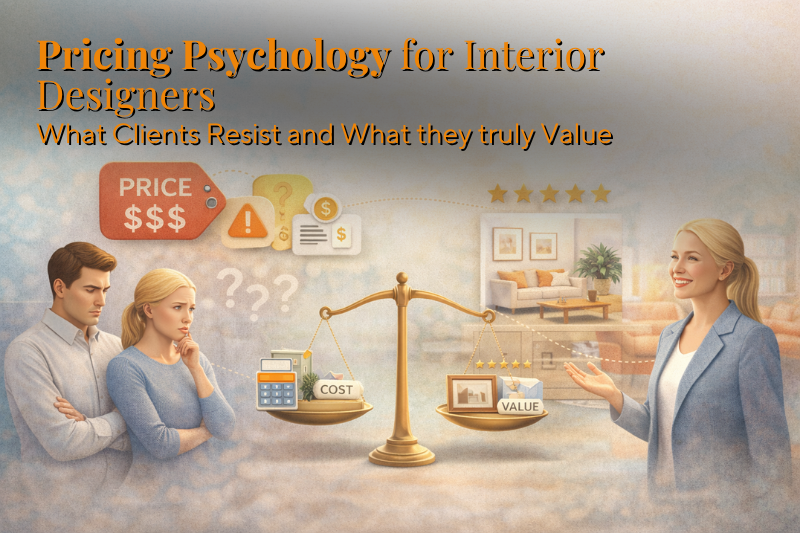
The Real Reason Clients Push Back on Pricing
Understanding why clients hesitate around pricing helps you address the real issue, not just the surface objection. In most cases, resistance isn’t about affordability; it stems from uncertainty, comparison, and unclear communication. When you identify these gaps, you can position your value more effectively and reduce friction in the decision-making process.
Lack of clarity about the work involved
Clients often see only the final outcome, not the detailed process behind it. Without visibility into planning, coordination, and decision-making, pricing can feel random instead of well-earned.
Commoditisation of design services
When clients equate design with furniture selection or decoration, they overlook the expertise involved. This comparison reduces perceived value and makes them more price-sensitive.
Confusion between cost and value
Cost-based thinking focuses on effort and inputs, while value-based perception highlights outcomes and impact. Clients are more willing to invest when they understand the transformation, not just the tasks.
Influence of psychological pricing perception
Through psychological pricing examples, it becomes clear that how pricing is framed affects how it is received. Clear positioning helps clients interpret pricing as an investment rather than an expense.
Unclear messaging and inconsistent positioning
Vague proposals and scattered communication create doubt. A structured and consistent approach ensures that every interaction reinforces clarity, reducing the likelihood of objections.
Understanding Value in Interior Design (Beyond Aesthetics)
To truly master pricing psychology for interior designers, you must expand how value is communicated. Design is not just about aesthetics, but it is about solving problems, improving functionality, and enhancing the client’s overall experience.
Clients often associate value only with visual outcomes, but the real impact goes much deeper. When you articulate both tangible and intangible benefits clearly, pricing starts to make sense in a more holistic way.
A. Tangible Value
Tangible value represents the measurable and visible outcomes of your work. These are the aspects clients can directly relate to, making them crucial in shaping pricing perception.
- Space optimisation: A well-planned layout ensures every square foot is used effectively, improving functionality and flow within the space.
- Budget efficiency: Strategic decision-making helps clients allocate resources wisely, avoiding unnecessary expenses while achieving better results.
- Vendor coordination: Managing vendors, timelines, and deliverables streamlines execution and minimises delays or miscommunication.
- Project management and timelines: Timely completion reduces indirect costs like extended rentals or operational disruptions, adding measurable value.
- Risk reduction and error prevention: Anticipating and avoiding mistakes saves time, money, and rework, leading to smoother and more reliable project outcomes.
B. Intangible Value
While tangible benefits are easier to explain, intangible value often holds even greater importance in pricing psychology for interior designers. These are the emotional and experiential outcomes that clients deeply care about.
- Peace of mind: Clients feel reassured when a professional manages the project, reducing stress and building trust throughout the journey.
- Reduced decision overwhelm: With countless choices involved, clients can feel fatigued. A skilled ArchDesignpreneur simplifies decisions, making the process smoother and more enjoyable.
- Confidence and leadership: Clear guidance and direction help clients feel supported, increasing their comfort and willingness to invest.
- Experience: Years of hands-on exposure help anticipate challenges and make informed decisions that save time and cost.
- Taste: A refined aesthetic sense ensures the design feels cohesive, balanced, and aligned with the client’s vision.
- Judgment: The ability to make the right decisions at the right time ensures both functionality and long-term relevance.
- Long-term livability and value: A well-designed space enhances everyday living and future resale potential, shifting perception from short-term cost to lasting investment.
Common Pricing Models Used by Interior Designers
Choosing the right pricing model is essential for aligning your services with client expectations. Each model has its own advantages and influences how clients perceive value.
A. Fixed Fee Pricing
Offers clear scope and a single upfront investment, giving clients predictability. It works best when deliverables and timelines are well-defined. Success depends on strong scope control and clear change order systems.
B. Hourly Pricing
Feels transparent but can undervalue expertise by focusing on time over impact. It often leads to scrutiny and shifts attention to effort instead of outcomes. Best suited for consulting or limited advisory work.
C. Percentage-Based Pricing
Ties fees to the overall project budget, making it ideal for larger projects. It scales naturally but requires clear explanation to avoid client uncertainty. When positioned well, it aligns with project success.
D. Retainer or Phased Pricing
Breaks the project into stages with separate fees, reducing upfront commitment. It offers flexibility while maintaining structure. Clients appreciate the step-by-step engagement approach.
E. Hybrid Models
Combines multiple pricing methods for greater flexibility. It adapts well to complex projects but needs clear communication to avoid confusion. When structured properly, it balances predictability and scalability.
Early-stage designers benefit from structure and predictability, while established practices can confidently price based on value and outcomes. Use pricing as a strategic tool that supports your current phase of growth, not as a rigid rule.
- Beginning phase (Niche still evolving): Fixed fee or retainer pricing works best as it offers clarity, builds client trust, and helps you refine your processes without pressure.
- Midway phase (Niche well-defined and value clearly positioned): Retainer or phased pricing allows you to charge for expertise while maintaining flexibility and long-term client relationships.
- Well-established phase (Strong positioning and proven results): Percentage-based or outcome-based pricing aligns your fees with impact, authority, and the scale of transformation you deliver.
Pricing Psychology for Interior Designers: Smart Budgeting vs Cheap Design
One of the most important distinctions in pricing psychology for interior designers is the difference between smart budgeting and cheap design. Clients often confuse cost-cutting with value, which can lead to poor decisions.
- Smart budgeting focuses on allocating resources where they matter most. It prioritises quality, functionality, and long-term benefits. This approach ensures that every investment contributes to the overall outcome.
- On the other hand, cheap design prioritises short-term savings over long-term value. While it may reduce initial costs, it often leads to higher expenses later due to repairs, replacements, or inefficiencies. This creates a cycle of dissatisfaction and additional spending.
Psychological pricing examples show that clients are more willing to invest when they understand the consequences of choosing cheaper alternatives. By clearly explaining these trade-offs, you help clients make informed decisions.
For an ArchDesign business, guiding clients toward smart budgeting is not just about pricing, but it is about responsibility. It positions you as a strategic partner rather than a service provider, strengthening trust and credibility.
When Value Is Clear, the Right Clients Self-Select
Clear value communication doesn’t just support your pricing, but it acts as a filter for the kind of clients you attract. When your expertise, process, and outcomes are clearly defined, only the right clients move forward, leading to smoother projects and stronger professional boundaries.
- Attracts aligned clients, not everyone: Clear messaging draws clients who value expertise and outcomes, not just low prices. These clients approach conversations with trust and a willingness to invest.
- Prevents price shoppers and resistance: When value is unclear, clients focus only on cost. Strong positioning shifts the focus to results, reducing unnecessary negotiations and objections.
- Reduces friction during projects: Aligned clients respect your process, timelines, and recommendations. This leads to smoother collaboration and faster decision-making.
- Protects time, energy, and profitability: Early self-selection filters out misaligned clients, saving effort and avoiding scope creep. This allows you to focus on more rewarding and sustainable projects.
Conclusion
Pricing psychology for interior designers is about more than setting numbers, but it is about shaping perception, communicating value, and building trust. When you move from explaining prices to demonstrating value, you create a stronger foundation for every client interaction.
As highlighted by Shanker De, the goal is not to justify your pricing but to position your expertise in a way that makes the investment obvious. This mindset shift is what drives consistent interior design business growth and helps you stand out in a competitive market.
If you found this helpful, share your thoughts in the comments: what part of pricing feels most challenging for you right now? Your perspective could help others navigating the same journey.
Understood the pricing psychology for interior designers? Ready to refine your pricing strategy and attract the right clients with clarity and confidence? Book a call today with our ArchScale Guild team and take the next step in strengthening your approach as an ArchDesignpreneur.

Shanker De is an ArchDesign Business Coach, entrepreneur, and Founder of ArchScale Guild. With 25+ years of experience across 330+ businesses in 15 countries, he helps the founders, principals and studio owners of growing ArchDesign firms, especially in Tier 2 & Tier 3 cities, turning inconsistent leads, silent sales and fluctuating revenue into predictable 2x–5x growth.
Using his proven ArchScale Business Growth Model (BGM), Shanker supports every ArchDesignpreneur in building a scalable ArchDesign business without founder burnout, underpricing, or constant overwhelm.