
Studying elevator pitch examples for interior design business is one of the fastest ways for professionals to gain clarity about how to communicate their value. When designers review well-structured pitch examples, they begin to understand how successful businesses simplify their message into a few powerful sentences. Instead of explaining everything they do, the focus shifts to communicating a clear problem, a defined audience, and a compelling result.
When an ArchDesignpreneur learns to clearly communicate transformation and value, conversations become more professional and impactful. As often emphasised by Shanker De, the ArchDesign Business Coach (ABC), business clarity begins with message clarity. This guide therefore explores practical elevator pitch examples for interior design business, structured frameworks, and a step-by-step exercise to help you craft a compelling pitch.
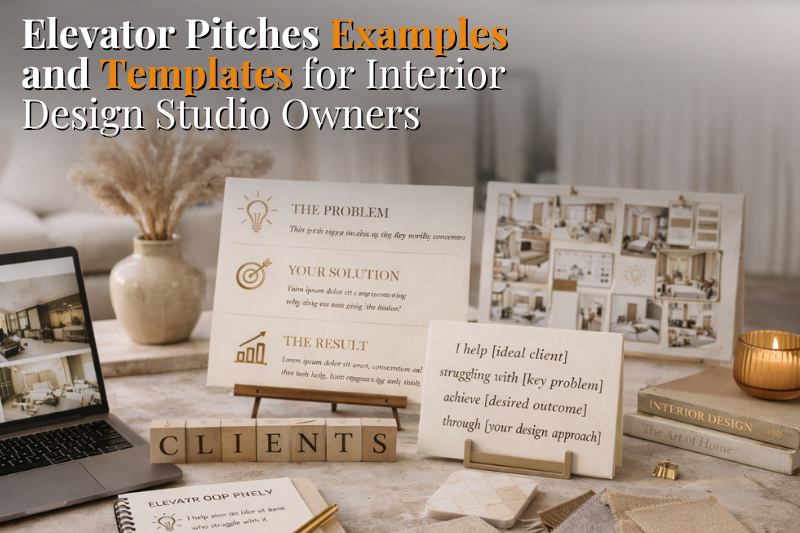
7 Elevator Pitch Examples for Interior Design Business
Many elevator pitch examples for interior design business follow proven frameworks used by entrepreneurs, consultants, and professionals. When adapted correctly, these frameworks help interior designers communicate their expertise in a simple and memorable way.
Different networking situations require different approaches: a premium pitch may suit luxury clients, while a niche pitch works better when targeting a specialised audience. Below are seven concise elevator pitch styles commonly used by design professionals.
A. Transformation-Focused Interior Design Elevator Pitch
“I help homeowners transform ordinary living spaces into highly functional and aesthetically refined environments that reflect their lifestyle. Through strategic design planning, we convert underutilised rooms into spaces that feel purposeful, organised, and inspiring.”
B. Niche-Specific Elevator Pitch for Interior Designer
“I specialise in designing small urban apartments for busy professionals who want maximum functionality without clutter. My process focuses on smart layouts, storage integration, and minimalist aesthetics that make compact spaces feel spacious and calm.”
C. Premium Positioning Pitch
“I work with luxury homeowners who want their interiors to feel curated rather than decorated. By combining architectural thinking with refined materials and bespoke design solutions, I create timeless interiors that elevate everyday living.”
D. Budget-Conscious Specialist Pitch
“I help first-time homeowners design beautiful interiors without overspending. My process focuses on strategic planning, smart sourcing, and phased implementation so clients can achieve stylish results while staying within budget.”
E. Commercial Interior Design Pitch
“I design productive and brand-aligned workspaces for growing businesses. By combining functional layouts with brand-driven aesthetics, I help companies create offices that support productivity and reflect their professional identity.”
F. Sustainable Designer Pitch
“I help environmentally conscious homeowners create beautiful interiors using sustainable materials and energy-efficient design strategies. The goal is to design spaces that are not only elegant but also responsible and future-ready.”
G. Renovation Expert Pitch
“I specialise in transforming outdated homes into modern, functional living spaces through thoughtful renovation design. My approach balances architectural improvement with interior styling to create homes that feel both fresh and timeless.”
Elevator Pitch Template for Business (Adapted for Interior Designers)
Understanding elevator pitch examples for interior design business becomes even more powerful when designers learn the frameworks behind them. It helps professionals structure their ideas instead of trying to invent a pitch from scratch. When designers follow a simple framework, the message becomes clearer and more persuasive.
Below are three powerful pitch frameworks that can be easily adapted for interior designers.
A. Problem–Solution Template
The Problem–Solution framework is one of the most widely used structures. It begins by identifying a clear problem faced by a specific group of people. Immediately after stating the problem, the designer introduces their service as the solution.
For interior designers, the problem could be disorganised homes, inefficient layouts, or outdated interiors. The solution then highlights how the designer transforms that challenge through design expertise. This format works well because it demonstrates that the designer understands the client’s frustrations.
Using this elevator pitch template for interior design business, a designer might say:
“I help families struggling with cluttered homes create functional and organised living spaces through strategic interior design planning.” This structure instantly connects with the client’s pain point.
B. Before–After Transformation Template
Transformation is a powerful storytelling tool used in many elevator pitch examples for the interior design business. This framework describes what the client’s situation looks like before the service and what it becomes afterward. By presenting a clear contrast, the designer highlights the value of their work.
Interior design is inherently transformational, making this template especially effective. A designer can explain how a poorly designed space becomes an organised, beautiful, and functional environment after professional intervention. The emphasis is on the journey from chaos to clarity.
A simple version of this elevator pitch template for business could be:
“I help homeowners turn outdated or poorly planned interiors into modern spaces that feel organised, comfortable, and visually cohesive.”
C. Authority + Specialisation Template
Another common approach seen in elevator pitches is the Authority + Specialisation framework. This format establishes credibility first and then highlights a specific niche or expertise. By emphasising specialisation, the designer becomes more memorable.
Interior designers can position themselves as experts in luxury homes, compact apartments, commercial workspaces, or sustainable interiors. When clients hear a specialised focus, they immediately associate the designer with that category.
A pitch using this elevator pitch template might sound like:
“I specialise in designing functional interiors for modern urban apartments, helping professionals maximise space while maintaining a clean and elegant aesthetic.”
Step-by-Step Exercise: Write Your Own Elevator Pitch
Many designers feel uncertain about how to start writing their pitch because they try to describe everything they do. However, the goal of an elevator pitch is not to explain every service but to highlight a specific problem and the result you create. For an ArchDesignpreneur, this clarity can significantly improve the way potential clients perceive the ArchDesign business.
The following four-step exercise will help you build a practical elevator pitch.
A. Define Your Ideal Client
The first step in writing an effective elevator pitch is identifying your ideal client. Instead of speaking to “everyone,” define a specific group such as homeowners, apartment dwellers, business owners, or luxury property buyers. The clearer the audience, the stronger the pitch becomes.
When designers define their ideal clients, their messaging becomes more relevant and targeted. Clients are more likely to engage with a pitch that directly reflects their situation and lifestyle. This step also helps designers align their services with the types of projects they enjoy most.
B. List Top 3 Problems You Solve
Every strong pitch begins with a problem worth solving. Interior designers often solve challenges such as inefficient layouts, outdated interiors, lack of storage, or poorly planned spaces. Identifying the top three problems you address helps focus your messaging.
Instead of describing design activities like selecting furniture or choosing colours, focus on the results those actions create. Clients care more about outcomes such as comfort, functionality, organisation, and visual harmony. Highlighting these outcomes makes the pitch more client-centred.
C. Identify Your Unique Differentiator
Your differentiator explains why clients should choose you over other designers. This could be a niche expertise, a specialised process, or a particular design philosophy. For example, you may focus on compact urban homes, eco-friendly design, or renovation-focused interiors.
Differentiation also helps position the designer as an expert rather than a generalist. When potential clients understand what makes your approach unique, they are more likely to remember you after the conversation ends.
D. Craft 3 Versions of Your Pitch
A strong pitch evolves through multiple versions rather than a single statement. Designers should prepare different lengths depending on the situation. Networking conversations, presentations, and discovery calls all require slightly different formats.
Create three versions of your elevator pitch:
-
- 10-Second Version: A quick one-sentence introduction used in networking situations.
- 30-Second Version: A short explanation including niche, problem, and result.
- 1-Minute Version: A slightly expanded version that includes your approach and unique expertise.
Practising these versions ensures that you can confidently introduce your work in any professional setting.
How to Refine and Test Your Elevator Pitch
Creating a pitch is only the beginning. The most effective elevator pitches are refined through real conversations and feedback. Designers should treat their pitch as a living message that evolves over time rather than a fixed script.
Testing and refining your pitch improves clarity and confidence. When designers consistently practise their message, it becomes more natural and conversational. Over time, the pitch begins to reflect the designer’s authentic voice and professional identity.
The following strategies help refine and strengthen your elevator pitch.
A. Say It Out Loud
A pitch that sounds good on paper may feel awkward when spoken. Practising the pitch aloud helps identify sentences that feel too complex or unnatural. The goal is to communicate clearly without sounding rehearsed.
Speaking the pitch several times also builds confidence. Designers become more comfortable introducing themselves and explaining their work in networking environments. Over time, the pitch begins to feel like a natural part of professional conversation.
B. Test It in Real Conversations
Real-world conversations provide the best feedback for your elevator pitch. Use your pitch when meeting potential clients, collaborators, contractors, or referral partners. Pay attention to how people respond when they hear it.
If the listener immediately understands what you do and asks follow-up questions, the pitch is working. If they appear confused, the message may need simplification. These real-world interactions are valuable opportunities to refine your communication.
C. Observe Questions People Ask
The questions people ask after hearing your pitch reveal how clearly your message is understood. If people repeatedly ask the same clarifying question, it may indicate that an important detail is missing from your pitch.
Designers can use these questions as clues to improve their message. Adding one clarifying phrase or adjusting wording can dramatically improve the pitch’s effectiveness.
D. Adjust Based on Clarity
Refinement is a continuous process. As designers gain more experience, their niche focus and expertise may evolve. Updating the elevator pitch ensures it always reflects the current direction of the business.
Over time, a well-refined pitch becomes a powerful communication tool that supports networking, marketing, and client acquisition.
Conclusion
A strong interior design elevator pitch opens the door to meaningful professional conversations. It helps designers explain their expertise clearly and confidently in just a few sentences. Instead of overwhelming listeners with details, the pitch highlights a clear problem and a compelling transformation.
The best elevator pitch examples for interior design business are not about impressing people with complicated language. They are about resonance that help the listener quickly understand who you help and the value you create. When designers focus on clarity and relevance, their message becomes far more memorable.
Developing your pitch is also an evolving process. As your experience, niche, and expertise grow, your pitch should evolve with them. Continually refining your message ensures that it always represents your current vision and professional direction.
If you found this guide helpful, share your elevator pitch in the comments below. And if you would like guidance on building a scalable ArchDesign busines, book a strategy call with Shanker De to explore how you can accelerate your growth.

Shanker De is an ArchDesign Business Coach, entrepreneur, and Founder of ArchScale Guild. With 25+ years of experience across 330+ businesses in 15 countries, he helps the founders, principals and studio owners of growing ArchDesign firms, especially in Tier 2 & Tier 3 cities, turning inconsistent leads, silent sales and fluctuating revenue into predictable 2x–5x growth.
Using his proven ArchScale Business Growth Model (BGM), Shanker supports every ArchDesignpreneur in building a scalable ArchDesign business without founder burnout, underpricing, or constant overwhelm.